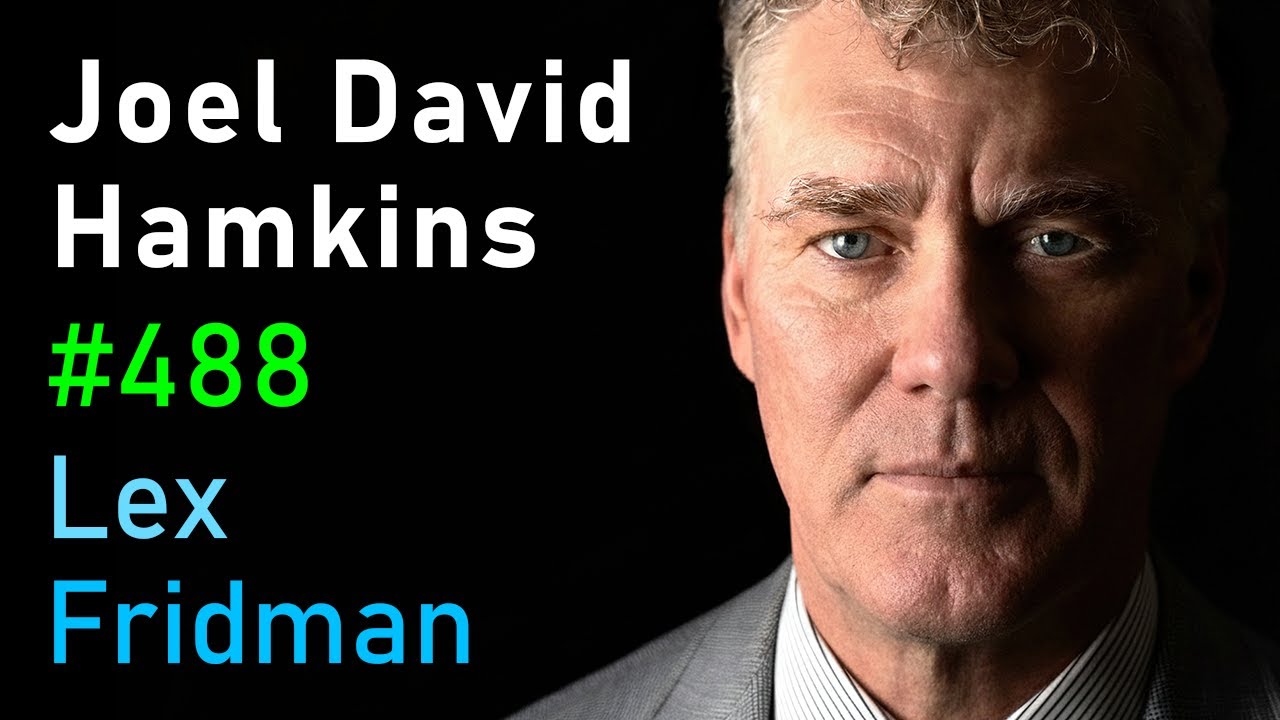
Infinity, Paradoxes, Gödel Incompleteness & the Mathematical Multiverse | Lex Fridman Channel #488
Introduction
Table of contents
• Introduction • Infinity and Cantor's Breakthrough • Countable and Uncountable Sets • Set Theory as Foundation of Mathematics • Paradoxes and Russell's Theorem • Gödel's Incompleteness Theorems and Mathematical Truth • The Continuum Hypothesis and its Independence • The Set-Theoretic Multiverse • Surreal Numbers and Infinite Chess • AI and Mathematics • Personal Reflections and Philosophical Outlook • The Limits and Promise of Computability and Complexity • Legacy and Ongoing InfluenceIn this podcast episode, Lex Fridman engages in a deep and wide-ranging conversation with Joel David Hamkins, a distinguished mathematician and philosopher specializing in set theory, infinity, and the foundations of mathematics. The discussion spans the conceptual and mathematical understanding of infinity, the paradoxes and crises that shaped modern logic, Gödel's incompleteness theorems, the axiomatic foundations of mathematics, the nature of mathematical truth, the multiverse view of set theory, infinite chess, surreal numbers, and reflections on AI's role in mathematics. Throughout, Hamkins shares both the technical insights and the human, philosophical aspects of this intricate domain.
Infinity and Cantor's Breakthrough
Hamkins begins by tracing the notion of infinity back through history, highlighting Aristotle's distinction between potential and actual infinity. While mathematics long clung to the idea of infinity as only potential, Galileo took steps that presaged modern set theory by observing paradoxical features of infinite sets, such as the one-to-one correspondence between natural numbers and perfect squares. This observation conflicted with the classical intuition that a part is smaller than the whole. Cantor revolutionized the understanding of infinity by rigorously demonstrating that infinite sets come in multiple sizes—some infinities are strictly larger than others—most notably that the set of real numbers is uncountably infinite and strictly larger than the countable infinity of natural numbers.
Hilbert's Hotel metaphor brings life to these abstract concepts: even a fully occupied infinite hotel can accommodate additional guests by clever relabeling. This illustrates the unusual and counterintuitive properties of infinite sets. The discussion also touches on countable unions of countable sets, illustrating how infinitely many countable infinities combine yet remain countable, using prime factorization and creative enumeration methods.
Countable and Uncountable Sets
Before delving into uncountable sets, Hamkins emphasizes the countability of rational numbers, which—despite their density—can be listed in correspondence with natural numbers. Cantor's diagonal argument then emerges as the core proof that real numbers cannot be listed and hence are uncountable. The construction of a real number differing at each diagonal digit from all purported elements of any enumeration defies the possibility of a complete listing, firmly establishing the existence of multiple sizes of infinity.
The conversation also stresses subtle points about decimal representations and how Cantor carefully sidestepped issues of non-unique decimal expansions by never using digits zero or nine in the construction, thereby preserving rigor.
Set Theory as Foundation of Mathematics
Set theory is presented with two complementary identities: as a field of mathematics itself and as the foundational framework underpinning all mathematics. Building on the idea of sets as collections treated as single abstract objects, Hamkins outlines the Zermelo-Fraenkel axioms with the Axiom of Choice (ZFC) as the standard modern foundation. This framework was developed in response to paradoxes like Russell's paradox, which exposed fundamental contradictions in naïve set theory.
Hamkins explains the Axiom of Choice, clarifying its intuitive but philosophically subtle nature using analogies such as choosing shoes versus indistinguishable socks, illustrating why its acceptance can be controversial. He highlights that ZFC's axioms codify the properties and operations on sets that allow the rigorous construction of mathematical objects and reasoning.
Paradoxes and Russell's Theorem
The conversation revisits Russell's paradox—the contradiction arising when considering the set of all sets that do not contain themselves. Hamkins reframes it as "Russell's theorem" showing there can be no universal set. Using elegant anthropomorphic analogies such as committees, fruit salads, and clothing drawers, the paradox is distilled to its essence, demonstrating why certain naive set constructions lead to contradiction.
Frege's tragic encounter with this paradox is discussed: his monumental project to reduce mathematics to logic was devastated just as his work was being published. The episode presents this as a humbling reminder of how deep foundational work can upend entire frameworks.
Gödel's Incompleteness Theorems and Mathematical Truth
Gödel's incompleteness theorems are introduced as the crowning moment of modern logic, decisively refuting Hilbert's program to find a complete, finitary foundation for all mathematics. The first theorem asserts that any sufficiently strong, computably axiomatizable system capable of encoding arithmetic cannot prove every truth about the natural numbers; there will always be true statements it cannot prove. The second shows such a theory cannot prove its own consistency.
Hamkins contrasts truth and provability with clarity, invoking Tarski's semantic definition of truth versus syntactic proof systems. He stresses the completeness and soundness of proof systems but notes that truth transcends what can be formally proven within any one system, underscoring the philosophical depth behind the distinction.
The Halting Problem and its undecidability showcase fundamental limits of computation, establishing that no algorithm can universally decide whether arbitrary computer programs halt. The podcast explores concrete diagonalization proofs connecting the halting problem to incompleteness, emphasizing their thematic unity with Cantor's and Russell's arguments.
The Continuum Hypothesis and its Independence
One of the central themes discussed is the Continuum Hypothesis (CH), which asks whether there exists an infinity strictly between the cardinality of the natural numbers and that of the real numbers. Cantor himself was deeply obsessed with this problem, and it was recognized as Hilbert's first problem, foundational to understanding infinite sets.
The historical journey covers work like Cantor-Bendixson's theorem for closed sets, the extension to broader classes of sets with large cardinal assumptions, and the ultimate proof of independence. Gödel showed that if ZFC is consistent, CH cannot be disproven, while Cohen introduced the method of forcing to demonstrate CH cannot be proved within ZFC either. This dual independence yielded a profound pluralism about set-theoretic truth: CH can neither be settled true nor false from the standard axioms.
The Set-Theoretic Multiverse
From these independence results, Hamkins elaborates his multiverse view of set theory: rather than one unique universe of sets with a definitive truth about CH, there exists a rich landscape of alternative set-theoretic universes—or "mathematical realities"—linked by forcing and other transformations, in which different statements hold. This pluralist perspective contrasts with the traditional "universe view," which posits one true set-theoretic universe and truth.
He discusses how this pluralism influences research directions, citing the work of Hugh Woodin (advocating a "universe" approach) and Hamkins' own explorations into "set-theoretic geology"—the study of forcing extensions and grounds, essentially reverse engineering forcing extensions to understand ancestral universes. These investigations reconcile philosophical views with cutting-edge mathematics and have productive interaction with differing foundational stances.
Surreal Numbers and Infinite Chess
The surreal numbers, introduced by John Conway, are portrayed as a beautiful and unifying number system combining the reals, ordinals, and infinitesimals into an all-encompassing class-sized ordered field built by a simple transfinite recursive generation rule. Despite their elegance and conceptual power, they exhibit fundamental discontinuities and lack the least upper bound property.
Infinite chess is introduced as chess played on an infinite board without edges, with suitably modified rules. Built from complex constructed positions, infinite chess reveals fascinating behaviors such as "mate in infinitely many moves" scenarios—positions where one player can force a checkmate but with an arbitrarily long game length controlled by the opponent, linked to ordinal game values.
Hamkins relates the creation of such chess positions to collaboration with both a philosophy professor and a chess master, highlighting the interplay of mathematical creativity and domain expertise.
AI and Mathematics
Hamkins offers a candid appraisal of current large language models (LLMs) in mathematical collaboration. While acknowledging their astonishing capabilities in some programming and creative contexts, he expresses skepticism about their utility in producing correct, reliable mathematical proofs. He warns that LLMs tend to generate text that resembles valid arguments without rigorous mathematical understanding, posing risks of deceptive or erroneous outputs in this delicate domain.
The discussion acknowledges diverse mathematicians' experiences with AI, and that careful prompting and human insight may allow AI to inspire rather than replace mathematicians. Nonetheless, Hamkins emphasizes that proof verification and true mathematical insight depend on genuine understanding rather than superficial text generation.
Personal Reflections and Philosophical Outlook
Throughout the conversation, Hamkins shares personal and philosophical reflections: the joy of collaborative mathematical exploration, the beauty he finds in simple and elegant proofs, and his preference for playful curiosity in problem-solving. He contrasts styles of mathematicians like Andrew Wiles, who intensely focused on a single problem, versus more exploratory mathematicians like Terence Tao.
His philosophical commitments include mathematical Platonism, structuralism, and a pluralist ontology that embraces the rich multiverse of mathematical universes. He challenges the conventional privileging of physical existence over mathematical existence by arguing we understand the abstract world better than the nature of physical reality.
Hamkins also reflects thoughtfully on the history of foundational crises, the evolution of mathematical knowledge, and the human aspects of mathematics as a creative, social pursuit fueled by wonder rather than external rewards.
The Limits and Promise of Computability and Complexity
Discussing computability, Hamkins describes probabilistic and statistical realities about the halting problem, including the surprising existence of "black holes" where halting can be decided for almost all inputs despite overall undecidability. This connects to notions of complexity and approximation algorithms in computer science, where many NP-complete problems have efficient solvers for typical cases even if worst-case hardness persists. These insights temper some of the extreme fears or hopes about computational limits.
The P vs NP question is addressed with philosophical caution, noting that even if P = NP or not, these complexity classes describe asymptotic behavior that is often irrelevant for realistic instance sizes. The discussion touches on open problems and the challenges of understanding deep mathematical and computational questions, a genuine frontier for future centuries.
Legacy and Ongoing Influence
Hamkins conveys his reverence for historical figures like Archimedes, Cantor, Gödel, Turing, and Conway, while emphasizing the evolving nature of mathematical insights. He recounts dramatic episodes—Frege's devastation by Russell's paradox, Cantor's own struggles with the continuum hypothesis, and Gödel's profound discoveries—as part of both the human and intellectual saga of mathematics.
The conversation closes with an affirmation of mathematics as a continuing journey of discovery, characterized by beauty, complexity, and the enduring mystery of the infinite.
Full episode
Episode summary