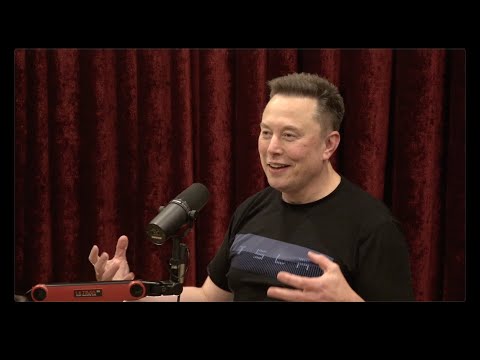
Elon Musk: A Different Conversation w/ Nikhil Kamath | Full Episode | People by WTF Ep. 16

Introduction
Table of contents
• Introduction • Social Media and the Future of Communication • Twitter's Political Balance and Moderation • Starlink and the Future of Global Connectivity • The Future of Work and Universal High Income • Philosophy of Collective Consciousness and the Meaning of Life • AI, Truth, Beauty, and Curiosity • The Evolution of Money and Energy as Currency • Population Dynamics and the Importance of Replenishment • Education, Skill-building, and Entrepreneurship in an AI World • Political Economy, Trade, and Business Challenges • Immigration and Talent Dynamics • The Matrix, Simulations, and Philosophical Musings • Technology, AI Creativity, and Media • Friendship, Emotional Connection, and Human Nature • History, Learning, and Recommended Resources • Value Creation and Advice for Young EntrepreneursThis extensive conversation with Elon Musk, hosted by Nikhil Kamath, dives deep into a wide array of topics—from social media evolution and the future of AI to space exploration, economics, society, and philosophy. The discussion is tailored for an ambitious Indian entrepreneurial audience, offering insights into Musk's vision for technology, the human condition, and the potential trajectories of civilization.
Social Media and the Future of Communication
Elon Musk elaborates on his vision for social media, primarily through the lens of X (formerly Twitter). He highlights that the platform serves as a "global town square," aiming to bring together a collective human consciousness across languages via automatic translations. Musk underscores the strength of X in serving readers, writers, and thinkers, differentiating it from platforms that rely heavily on dopamine-driven video content. While video is becoming dominant across the internet, he emphasizes the enduring value of concise, high-density text communication.
Regarding the future of social platforms, Musk foresees a shift toward real-time AI-driven video interactions, with powerful video comprehension and generation capabilities. However, he expresses caution about the addictive nature of dopamine-centered content and stresses the importance of meaningful interactions over brainless entertainment. Musk's broader goal is to facilitate global understanding and idea exchange, transcending language and cultural barriers.
Twitter's Political Balance and Moderation
Reflecting on his acquisition of Twitter, Elon Musk discusses the platform's prior ideological tilt, which he characterizes as strongly left-wing, primarily due to its San Francisco roots and content moderation policies. His effort since taking ownership has been to restore balance and centrism by adhering to local laws without bias and not suppressing voices based on political leanings. He notes some users left voluntarily but insists no group has been disproportionately censored under his stewardship.
Starlink and the Future of Global Connectivity
Musk provides a detailed explanation of the Starlink satellite internet system, which involves thousands of low Earth orbit satellites interconnected through laser links to create a resilient, low-latency global network. He illustrates Starlink's particular strengths in rural and disaster-affected regions where terrestrial infrastructure is weak or damaged. However, he clarifies that physics limits the system's efficacy in densely populated urban areas due to the distance of satellites from users, making traditional cell towers more efficient for cities.
Discussing India's development path, Musk notes urbanization trends but considers future productivity gains from AI might reduce the necessity of living in cities, potentially allowing more people to live rurally with better quality of life. He predicts that in less than 20 years, advances in AI and robotics will make work optional for many, signaling a dramatic societal shift.
The Future of Work and Universal High Income
Elon Musk envisions a near future where working is optional, enabled by the productivity unleashed by AI and robotics. In this world, goods and services would be abundantly available, reducing or eliminating the need for traditional labor. He contrasts this with evolutionary human competitiveness, accepting that once basic needs are met universally, traditional forms of competition might transform or diminish. Musk also touches on the concept of marginal utility, suggesting that excess abundance, like having too many marshmallows, diminishes value.
This vision aligns with his broader idea of Universal High Income (UHI), where prosperity does not strictly depend on individual labor, and wealth can be broadly distributed through technological abundance. He acknowledges uncertainties in how social dynamics will adapt but is confident that automation and AI will reshape the economy fundamentally.
Philosophy of Collective Consciousness and the Meaning of Life
Musk engages deeply with concepts of collective consciousness, comparing human society to a vast cellular organism where the organization of trillions of cells leads to emergent qualities not present at the individual cell level. Extending this idea, he posits that humanity's collective intelligence and collaboration enable achievements impossible for individuals alone, like building spaceships.
He links this to the pursuit of understanding the universe and the meaning of life. Drawing inspiration from Douglas Adams' "Hitchhiker's Guide to the Galaxy," Musk suggests that formulating the right questions about existence is more crucial than simply searching for answers. His philosophy emphasizes increasing the scope and scale of consciousness—both individual and collective—to better grasp unknown cosmic truths.
AI, Truth, Beauty, and Curiosity
Elon Musk's vision for AI centers around three core values: truth, beauty, and curiosity. He stresses that AI must adhere strictly to truth, as forcing AI to believe falsehoods risks producing harmful and irrational outcomes. Using literary examples such as HAL 9000 from "2001: A Space Odyssey," Musk warns against programming AI to lie or conceal truths.
Beauty is more ephemeral but essential for AI to appreciate, and curiosity should drive AI to explore and better understand reality. With these values in place, Musk anticipates a symbiotic future where AI supports humanity's growth and prosperity rather than undermining it. He sees this as a promising path forward that can prevent dystopian scenarios often depicted in popular culture.
The Evolution of Money and Energy as Currency
The conversation turns to economics as Musk predicts the gradual disappearance of money as a concept. In a world where AI and robotics provide near-limitless goods and services, traditional monetary systems as a database for labor allocation lose relevance. Instead, Musk envisions energy as the fundamental currency since it underpins all useful work.
He connects this idea to the Kardashev scale of civilization progress, where mastery over increasing proportions of energy from the planet, star, and galaxy correlates with advancement. Musk sees solar-powered AI satellites in deep space as a step toward an almost infinite energy harnessing system, making wealth accumulation conventional money cannot represent.
Population Dynamics and the Importance of Replenishment
Elon Musk expresses concern about declining global fertility rates and population shrinkage, which he views as problematic for the continuation of humanity and consciousness expansion. Fewer humans mean fewer collective minds to tackle existential questions about reality. He argues for the necessity of having children, both as a biological imperative and as a contribution to society's collective intelligence.
Musk comments on familial structures, endorsing the "one child, one mother, one father" model as effective for most people while recognizing personal variations and cultural shifts. He acknowledges that parenting demands considerable time and emphasizes quality of engagement. To Musk, having children fosters a unique love and a chance to experience the world with fresh eyes through their developmental journey.
Education, Skill-building, and Entrepreneurship in an AI World
For young entrepreneurs, particularly in India, Musk offers unconventional advice by questioning the continued relevance of traditional education like MBAs. While he appreciates college for social interactions and broad-based learning, he predicts AI and robotics will substantially change the skills landscape, making some formal education obsolete.
He encourages entrepreneurs to focus on creating value by building useful products and services that create more value than they consume. Pursuing entrepreneurial endeavors requires grit and acceptance of risk and failure but generates satisfaction and financial success if centered on real contributions.
Political Economy, Trade, and Business Challenges
Discussing politics and business, Musk cautions against deep involvement in politics, describing it as a "blood sport" where outcomes are often unpleasant. He shares frustrations from his DODGE project focused on rooting out fraud in government spending, illustrating the complexity and resistance involved in promoting transparency and efficiency.
On trade, Musk stands firmly against tariffs, arguing they distort markets and impede efficiency. He extends this to international trade, asserting that tariffs between countries harm global economic health just as tariffs within states or cities would be untenable.
Immigration and Talent Dynamics
Musk acknowledges America's historic benefit from skilled immigrants, notably from India, but notes current shifts toward tighter border controls and anti-immigration policies. He emphasizes the necessity of attracting global talent to meet technical challenges at his companies and criticizes misuse of visa programs that exploit the system for outsourcing.
He advocates maintaining avenues for skilled immigration to foster innovation and growth while calling for reforms to address abuses.
The Matrix, Simulations, and Philosophical Musings
The conversation explores the hypothesis that humanity might be living in a simulation. Musk suggests the likelihood is high, based on the rapid development of video game realism and AI sophistication, and the notion that simulations are usually run for "interesting" outcomes.
He argues that the nature of reality is layered and possibly nested with multiple simulations. He references philosophical ideas from Spinoza about morality existing independent of religious doctrine and asserts that societies function based on common sense and shared moral principles without necessarily requiring religious mandates.
The interview also touches on the evolution of religion's role in society and the positive principles underlying many faiths, such as empathy and treating others as one would want to be treated.
Technology, AI Creativity, and Media
Elon Musk predicts that content creation—including movies, podcasts, and games—will become overwhelmingly AI-generated in real time. He observes that novelty in live events will retain value due to the scarcity of authentic shared experiences as digital content becomes ubiquitous and nearly free.
He discusses the nuances of comedy, humor, and their role in society. Musk imagines that AI could master comedy, even vulgar roasts, with a high degree of sophistication, and reflects on comedy's social function as a form of truth-telling that might otherwise be difficult to express.
Friendship, Emotional Connection, and Human Nature
The discussion examines what friendship means to Musk on an emotional and intellectual level. He values friends who resonate with him both emotionally and philosophically and who provide support in difficult times. Musk admits to enjoying conversations on complex topics but recognizes the limits of such discussions in social environments.
He reflects on the nature of social popularity, power, and the impermanence of human connections, advocating for friendships based on admiration, respect, and mutual support rather than convenience.
History, Learning, and Recommended Resources
Musk expresses a passion for history, particularly German and world history related to the World Wars. He recommends podcasts like "Hardcore History" by Dan Carlin and reads like William Durant's "The Story of Civilization" for deep dives into human progress.
He shares insights about the English language as an "open source" language that actively incorporates foreign words, enriching communication. This linguistic openness parallels the broadening of consciousness and exchange that Musk envisions socially and technologically.
Value Creation and Advice for Young Entrepreneurs
Concluding thoughts for the entrepreneurial audience highlight the paramount importance of creating more value than one takes from society. Musk urges hard work, resilience, and focus on building useful products and services rather than chasing money directly. He stresses that success comes as a natural result of value creation and encourages aspiring founders to embrace risk with realistic expectations about failure.
This ethos underscores Musk's broader vision for a world driven by innovation, collective progress, and expanding human understanding.
Full episode
Episode summary