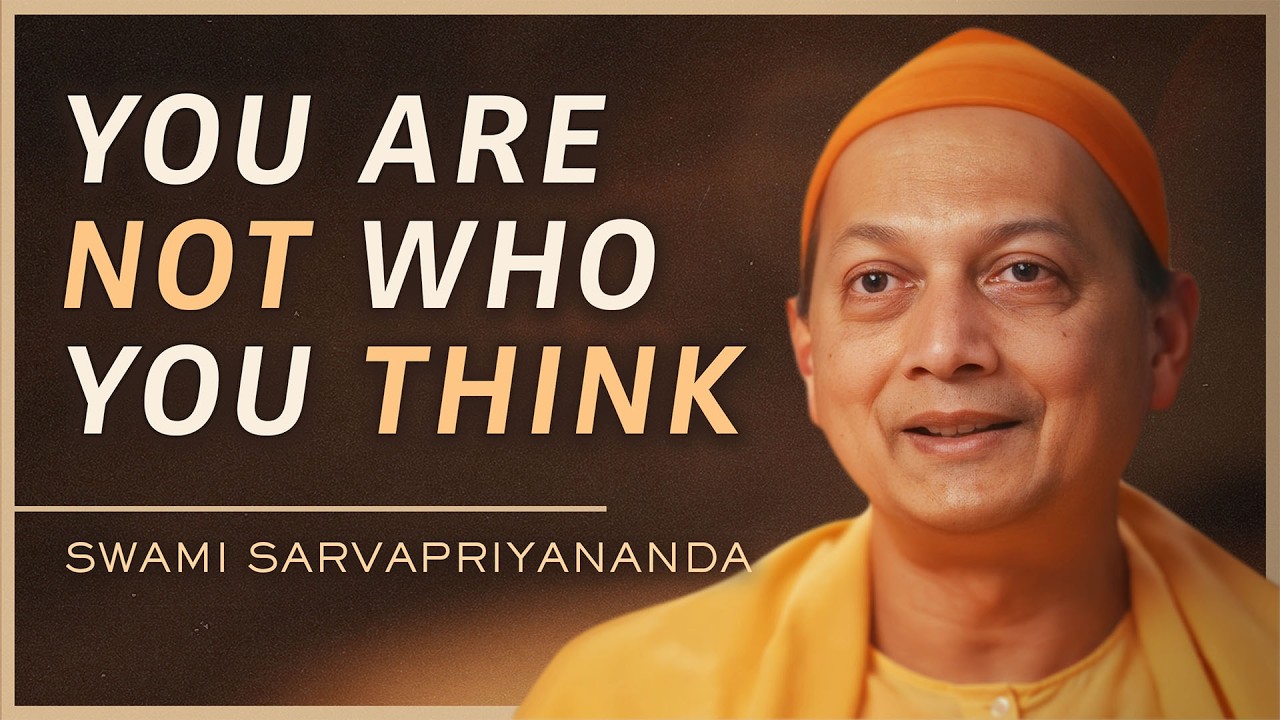
The Greatest Discovery About the Self & Reality | Swami Sarvapriyananda
Introduction
Table of contents
• Introduction • Advaita Vedanta and Its Foundations • The Promise and Goal of Spiritual Practice • The Nature of the Self: Consciousness vs. Body and Mind • Consciousness and the Universe: Non-Duality Explained • Guided Inquiry into the Self • Renunciation Revisited: Inner Orientation, Not External Withdrawal • The Nature and Thinning of the Ego • Love and Non-Duality • Integration with Daily Life and Dharma • Suffering, Ignorance, and the Illusory Nature of the World • Reincarnation and Continuity of Consciousness • The Complementarity of Spirituality and Psychological Development • Experiential Insights and the Long Path Ahead • The Importance of Sincerity and Sticking to PracticeIn this podcast episode, Swami Sarvapriyananda explores profound themes related to the nature of the self, consciousness, and reality from the perspective of Advaita Vedanta. The conversation delves into the essence of spirituality, non-duality, the relationship between mind and consciousness, the meaning of renunciation, the role of ego, and the integration of psychological growth with spiritual realization. He also offers guided inquiry practices and reflections on how spirituality can harmonize with daily life and personal dharma.
Advaita Vedanta and Its Foundations
Swami Sarvapriyananda begins by situating Advaita Vedanta as an ancient Indian non-dual spiritual philosophy centered on the ultimate quest for understanding reality—both the world and the self. Rooted in the Upanishads, Bhagavad Gita, and Brahma Sutras, Advaita proposes that the fundamental truth is that Brahman (the ultimate reality) alone is real, and the individual self (Atman) is none other than Brahman. This core teaching, often summarized as "You are That," expresses the radical unity between the individual consciousness and the universal existence.
Unlike faith- or experience-based paths, Advaita emphasizes a threefold method of hearing (śravaṇa), reasoning (manana), and meditation (nididhyāsana) to arrive at self-realization. The tradition acknowledges multiple spiritual paths but uniquely highlights rigorous self-inquiry as a way to intellectually grasp and experientially realize this oneness.
The Promise and Goal of Spiritual Practice
The promise of Advaita is profound: freedom (moksha) from the cycle of birth and death (samsara), which represents the repetitive experience of suffering and limitation. This goal corresponds to lifelong liberation, or jīvanmukti—being free while still living in the body. Sarvapriyananda recognizes that for those unfamiliar with reincarnation, this promise can be expressed as the attainment of deep, lasting happiness and the transcendence of suffering in the present life. He draws parallels with Buddhist nirvana and Western ideals of life, liberty, and happiness, emphasizing that true liberation is possible here and now without deferring fulfillment to an afterlife.
The Nature of the Self: Consciousness vs. Body and Mind
Through careful phenomenological analysis, the Swami invites us to distinguish ourselves from the physical body and the mind. The body, perceived as an object, is ever-changing—aging, growing, decaying—while the self that experiences the body remains constant and unchanging. This experiential duality between subject and object underpins the inquiry.
Extending this distinction inward, the breath and mind are further observed as changing phenomena that cannot be identified as the constant self. Even thoughts and feelings, which arise and fade, are objects of consciousness and thus distinct from the pure subject that observes them.
Crucially, Advaita teaches that consciousness itself is the unchanging essence that is aware of the body, breath, and mind but is not identical to them. This pure consciousness, often metaphorically described as "bare light," cannot be objectified and stands as the fundamental reality of the self.
Consciousness and the Universe: Non-Duality Explained
Having established the self as pure consciousness distinct from body and mind, Sarvapriyananda addresses the critical question of the relation between consciousness and the world. Through analogy and reasoning, he explains that the universe—though seemingly separate from us—is not ontologically distinct from consciousness. Like waves are to water, the multiplicity of objects and beings is a manifestation of one undivided reality.
This vision embodies the essence of non-duality: there is no real second entity apart from consciousness. The world and all experiences are Brahman appearing as manifold forms through maya (illusion or appearance). Understanding that we are both the pure seer and the substance of the seen removes the sense of separation and leads to direct realization.
Guided Inquiry into the Self
Swami Sarvapriyananda offers a meditative inquiry practice encouraging listeners to examine their sense of self through direct observation—investigating the body, breath, mind, intellect, and the spaces between. By witnessing the constant changes within these layers and recognizing the self as the unchanging witness, one can experientially grasp the truth of "I am not the body, not the mind, but the pure consciousness illuminating all."
This inquiry dismantles the habitual identification with impermanent phenomena, culminating in a stabilized sense of self as the pure awareness underlying all experience, present continuously whether awake, dreaming, or in deep sleep.
Renunciation Revisited: Inner Orientation, Not External Withdrawal
The discussion turns to the essential role of renunciation (vairāgya) in spiritual progress, clarifying common misconceptions. Renunciation is not about physical withdrawal from the world or a bitter rejection of life but is an internal attitude of dispassion and non-dependence on external conditions for fulfillment. True renunciation arises from realizing one's completeness as pure consciousness, which renders desires and fears inoperative.
Swami Vivekananda's teachings underscore this as the turning point for all yogas. The ideal is to live in the world—whether monastic or householder—without attachment, seeing divinity in all beings and things, thereby embracing life with renunciation of selfish craving. The analogy of loving possessions without being possessed by them beautifully captures this balanced engagement.
The Nature and Thinning of the Ego
Addressing common questions about ego from a monastic perspective, Sarvapriyananda explains that although living a monastic life provides structural support to reduce ego-centeredness (through disciplined service, devotion, meditation, and philosophical inquiry), the ego itself—a sense of self—is not easily discarded. The process is one of gradual "thinning out."
The ego's unripe form is identification with body, relationships, and possessions; spirituality aims to sever these delusions. However, a "ripe" or mature ego remains as the witness or pure consciousness observing all phenomena. Practices that calm the restless mind weaken the ego's grip, and devotion inspires humility and surrender, all contributing to ego transcendence.
Love and Non-Duality
When discussing love, Swami Sarvapriyananda points to the Advaita perspective that all love is ultimately self-love, as we love others for the joy and fulfillment we find within ourselves. Since the true self is the one universal consciousness shared by all, loving another is to love the self inherently present in them.
This realization transforms love from a limited, transactional, and conditional exchange into unconditional love that flows spontaneously from recognizing the unity of all beings. Gradually, this deep, non-dual love fosters healthier and more fulfilling relationships free from dependency and possessiveness.
Integration with Daily Life and Dharma
The Swami discusses how spirituality seamlessly integrates with one's dharma or intrinsic calling—what it means to live in alignment with one's highest ideals and nature. He encourages followers to seek their own highest, noble ideals rather than external approval or superficial notions of success.
The spiritual path requires ongoing inquiry, meditation, devotion, and selfless service (the four yogas) to stabilize wisdom and embody realization in daily life. Spiritual progress is neither instantaneous nor easy; it needs steady practice and character development to translate awakening into living reality.
Suffering, Ignorance, and the Illusory Nature of the World
Addressing the problem of suffering, the podcast clarifies that suffering arises from ignorance of our true nature. Enlightenment does not negate the physical realities of pain, aging, or death but transforms the relationship to them by removing the second arrow—the mental and emotional reaction to suffering—so that it no longer causes existential distress.
The world's apparent dualities and tragedies lose their grip once one is established in self-knowledge. The metaphor of the movie screen illustrates how the ultimate reality underlies all appearances; knowledge allows us to appreciate the phenomenal world without being bound by suffering.
Reincarnation and Continuity of Consciousness
Swami Sarvapriyananda briefly touches on the traditional Indian view of reincarnation and karma as logically coherent frameworks explaining the continuity of personal tendencies and consequences beyond a single lifetime.
The physical body dies, but the subtle body—comprising the mind, vital energy, and intellectual faculties—carries samskāras (latent impressions and habits) and continues into new births. This subtle continuity preserves individuality in a broad sense, allowing karmic effects to manifest even as the physical form changes.
The Complementarity of Spirituality and Psychological Development
Responding to the intersection of Eastern spirituality and Western psychology, the Swami acknowledges the importance of character-building and psychological growth as necessary supports for spiritual awakening. While spirituality remains the core, integrating modern psychological insights—such as those from positive psychology and psychotherapy—can aid in polishing the "mirror" of the mind, making self-realization more sustainable.
He emphasizes that spiritual maturity does not dismiss emotional or psychological work but includes it, preventing dissociation or unhealthy denial and equipping seekers to embody enlightenment holistically.
Experiential Insights and the Long Path Ahead
Reflecting on his personal journey as a monk since 1994, Sarvapriyananda humbly observes that spiritual progress is gradual and ongoing. Formal monastic life offers a supportive structure that removes distractions and fosters disciplined practice, which steadily ripens the spiritual qualities in the individual.
He explains that even after decades of practice, the ego and conditioned tendencies persist but are increasingly thinned through service, devotion, meditation, and inquiry. The "ripe ego" remains the necessary witness and agent in the spiritual process.
The Importance of Sincerity and Sticking to Practice
The conversation closes with a reflection on the essential role of sincere, persistent practice in progressively stabilizing wisdom and embodiment of spiritual truths. The Swami highlights the roles of faith, devotional surrender, altruistic service, meditation, and continuous self-inquiry in nurturing a steady realization that informs all aspects of life, ultimately leading to peace and fulfillment.
Full episode
Episode summary